Understanding Mattress Types: Memory Foam, Latex, Innerspring, and Hybrid Explained
The main types of mattresses differ in how their comfort layers and support cores respond to weight. Memory foam usually contours slowly, latex tends to rebound quickly, and coil-based beds offer varying degrees of bounce. Construction details matter more than the category name, so use these differences to choose what to test.
By the Sleep Comfort Insights editorial team at Essential Systems · Last reviewed
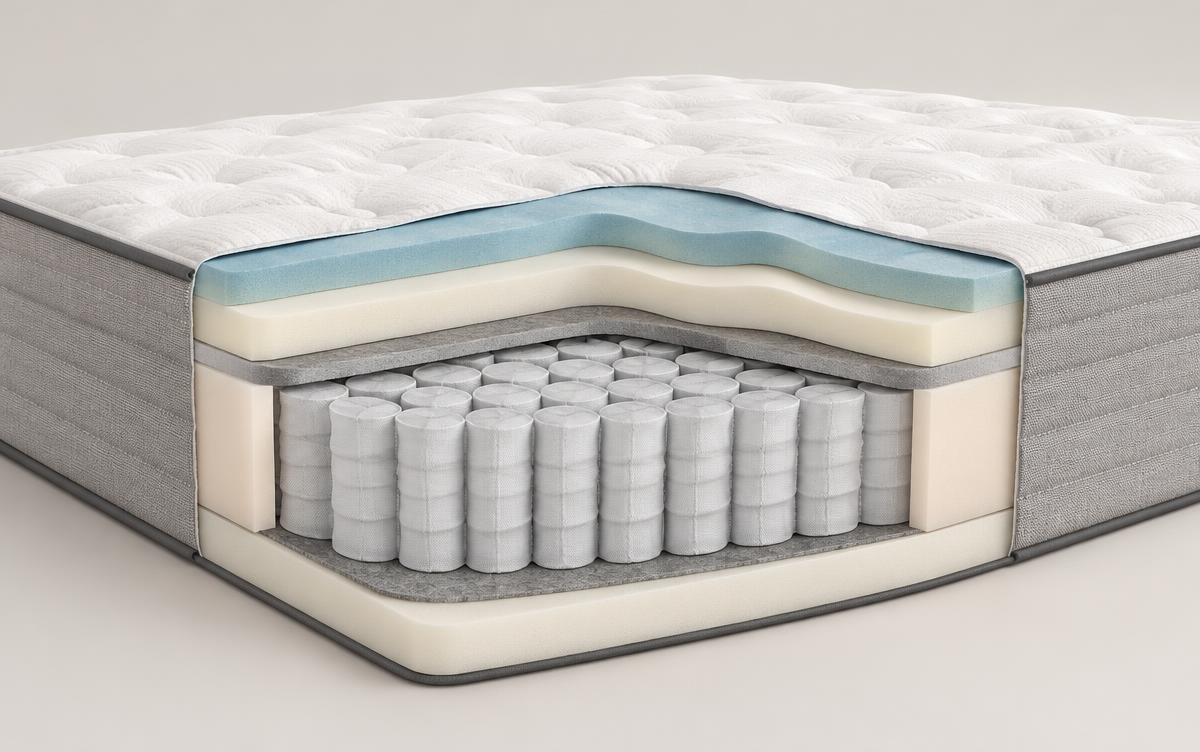
Understand the layers first
Most mattresses combine a cover, comfort layers, and a support core. Comfort layers shape the first impression and cushion prominent areas; the core provides deeper resistance. Transitional layers can help prevent an abrupt change between the two. A bed marketed as memory foam usually contains other foams too, while a hybrid typically combines a coil core with substantial foam or latex cushioning.
These labels are not medical classifications and are not perfectly standardized. Two hybrids may feel less alike than a hybrid and an all-foam mattress. Ask what each layer contains and how thick it is. Our mattress terminology glossary explains common descriptions, while choosing the right mattress turns that information into a practical shopping plan.
Memory foam: a close, slower contour
Memory foam is viscoelastic polyurethane foam. It changes shape under load and typically responds more slowly than latex, creating a cradling sensation. That can distribute pressure around shoulders and hips and reduce the movement reaching a partner. Depending on the formulation and room conditions, the feel may change with temperature. Not every foam bed has the same response speed or depth of sink.
The trade-off is that some sleepers feel enclosed or find turning harder. Deep contouring and less airflow around the body can also feel warm. Gel, perforations, or a cooling cover may alter performance, but the label alone does not prove comfortable overnight temperature. Review memory foam mattresses if pressure relief and motion isolation are your main priorities.
What to check
- Ask for comfort-layer thickness and foam density when available; density is not a firmness score.
- Try rolling over and getting out of bed rather than judging only the initial hug.
- Compare temperature with ordinary bedding, not just the cool feel of an uncovered showroom surface.
Latex: buoyant cushioning
Latex foam generally compresses and springs back quickly. Many sleepers describe resting more on top of it than inside it, although softer latex can still contour substantially. This responsiveness can suit people who change position frequently. All-latex beds can be heavy, and movement may travel more readily than on some slow-response foam beds. Edge performance depends on the complete design.
Latex may be natural, synthetic, or blended. Natural content does not automatically establish that the entire mattress is organic or environmentally superior. Certifications address particular materials or processes, not every possible health or sustainability claim. If you have a known latex allergy, discuss suitability with your clinician and ask the manufacturer about composition and exposure rather than assuming a covered mattress is appropriate. Learn more in our latex guide.
Innerspring: coils with lighter cushioning
Traditional innerspring designs put greater emphasis on the spring unit, with relatively modest cushioning above it. Connected coils can create a lively feel and transfer movement across the surface. Individually wrapped coils can respond more locally, though comfort layers still influence motion isolation. Open space in a coil core permits airflow, but a warm cover or thick bedding can limit the benefit.
People who prefer bounce and less contour may enjoy this type. Those with pressure-sensitive shoulders or hips may need more cushioning than a thin upholstered surface provides. Coil gauge, shape, arrangement, and edge reinforcement interact; neither a high count nor a thick wire alone identifies the best design. Our innerspring guide covers these features in greater detail.
Hybrid: coils plus substantial comfort layers
A hybrid uses a coil support core with thicker foam or latex comfort layers than a traditional innerspring typically has. The intended balance is pressure relief above responsive support. A memory-foam hybrid may feel close-contouring, while a latex hybrid may feel more buoyant. The word hybrid does not guarantee that a bed is cooler, firmer, or more durable than an all-foam alternative.
Hybrids can be heavy and may cost more than simpler constructions. Their motion transfer and edges vary considerably. Look at the thickness of the comfort stack, the transition into the coils, and whether the edge uses reinforced springs or foam. Visit hybrid mattresses for a closer look at what those choices mean in everyday use.
Compare tendencies, not promises
| Type | Typical strengths | Potential drawbacks | Useful test |
|---|---|---|---|
| Memory foam | Close contour, motion damping | Heat or slower turning | Change position several times |
| Latex | Quick response, buoyant feel | Weight, bounce, variable edges | Check pressure and partner movement |
| Innerspring | Bounce, open coil core | Pressure or transferred movement | Lie on your side and test together |
| Hybrid | Mixed cushioning and coil response | Weight, variable construction | Check contour depth and edge feel |
Match the material to your priorities
Start with the discomfort you want to solve. For pressure, compare cushioning without allowing the pelvis to sink excessively. For movement, compare responsiveness and the effort needed to turn. For a shared bed, test both motion transfer and usable space. Our memory foam versus latex comparison and innerspring versus hybrid comparison help refine a shortlist.
No material reliably treats a spinal condition. Comfortable support, a suitable foundation, and an accessible return process matter more than a therapeutic-sounding label. If back pain is the reason for shopping, read the back pain mattress guide and seek assessment for persistent symptoms. Check trial terms before deciding whether a category that sounds attractive actually suits you at home.
Frequently asked questions
Which mattress type lasts longest?
There is no guaranteed category-wide lifespan. Material quality, layer thickness, loading, foundation support, and care all affect wear. Compare disclosed construction and warranty exclusions rather than relying on a universal replacement schedule.
Is a hybrid always better than foam?
No. A hybrid may be easier to move on, but a foam bed may isolate movement better for a particular couple. Individual designs overlap, so test the features you value.
Are all foam mattresses memory foam?
No. Many use conventional polyurethane foam without memory foam, and most memory foam beds contain other foams in their support layers. Read the actual material list.
Do coils make a mattress firm?
Not necessarily. Coil design and the layers above it determine the combined feel. Both plush and firm mattresses can use coils.
Ready for the next step?
Build your buying checklist