The Science of Sleep and Spinal Alignment: Optimizing Health and Well-being
Sleep science and spinal alignment overlap, but they do not establish one ideal mattress or a single perfect sleeping posture. Your mattress influences pressure, comfort, and ease of movement, while pain and poor sleep can reinforce each other. Understanding those relationships helps separate useful advice from unsupported treatment claims.
By the Sleep Comfort Insights editorial team at Essential Systems · Last reviewed
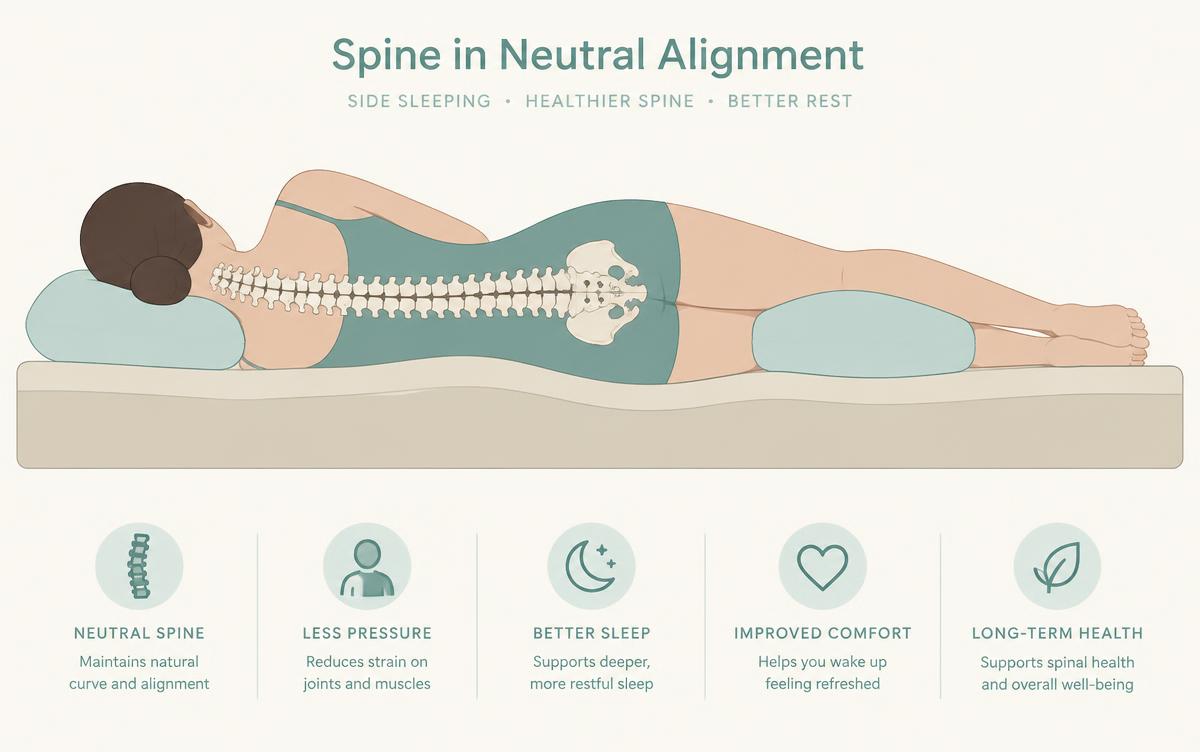
Alignment is a range, not a rigid pose
The spine has natural curves, and their shape changes with position. Comfortable alignment does not mean forcing the back flat or preventing all movement. A mattress supports the body from below, while pillows, joint mobility, body shape, and sleeping position influence the final posture. A diagram with a straight line through a sleeper is an illustration, not a diagnostic test.
A photograph cannot reliably show internal loading, nerve function, or the source of pain. It also captures only one moment in a moving night. Avoid products that promise to correct every spinal curve or prevent degeneration solely through a special surface. The more useful question is whether you can rest and change position without uncomfortable pressure or a deep, unstable dip.
Pressure relief and support work together
When you lie down, prominent areas such as the shoulders and hips load the surface differently from the waist. Cushioning allows those areas to settle, while deeper layers resist excessive sinking. Too little cushioning can feel sharply pressurized. Too much compression under a heavier region can make a posture uncomfortable. Neither effect alone proves tissue damage or explains every case of morning stiffness.
Firmness is therefore only part of the picture. A soft top over a stable core may work well for one person, while a harder surface may not suit another. Our firmness scale explains the limits of surface labels. The back pain mattress guide shows how to evaluate pressure, movement, and support together.
Sleep and pain influence each other
Pain can make it harder to fall asleep or stay asleep. Disrupted sleep can also increase sensitivity to pain and make coping more difficult. This two-way relationship is well recognized, but it does not mean every poor night reflects a mattress problem. Stress, medications, illness, work schedules, and sleep disorders can affect both symptoms and rest.
Sleep supports attention, mood regulation, and many normal physiological processes. A more comfortable bed may remove an obstacle to sleep, but that is different from proving a mattress improves neurological function or treats a disease. Read sleep quality and overall health for broader context. Treating an identified sleep disorder or medical condition may matter far more than changing bedding.
What mattress research actually supports
A real, frequently cited trial by Kovacs and colleagues published in The Lancet in 2003 compared firm and medium-firm mattresses in adults with chronic nonspecific low back pain. It found better outcomes with medium-firm mattresses. This is useful evidence against the blanket claim that the hardest available surface is best for everyone with back pain.
The study does not establish a universal firmness number, endorse current commercial products, or show that a particular material cures pain. Mattress studies can be difficult to compare because labels, construction, participant characteristics, and outcome measures vary. Many results depend on self-reported comfort and pain, which are meaningful but do not directly measure spinal correction. A single study should inform a starting point, not dictate a purchase.
Read scientific claims with a checklist
| Claim | Question to ask | Reason for caution |
|---|---|---|
| Clinically proven support | What was measured, and in whom? | Comfort scores are not proof of treating disease |
| Perfect spinal alignment | How was alignment assessed? | An illustration or photograph may not establish clinical benefit |
| Pressure-map superiority | Were real sleep outcomes evaluated? | A pressure map is a snapshot, not a full night |
| Doctor recommended | Which professional and what relationship? | An endorsement is not independent trial evidence |
Look for a clear distinction between laboratory testing, user preference, and clinical outcomes. Mechanical testing can describe resilience or pressure distribution, but cannot by itself prove relief of sciatica or insomnia. Check whether the participants resemble you and whether the comparison is relevant. Funding and commercial relationships should be disclosed so readers can judge possible bias rather than assuming either sponsorship or independence guarantees accuracy.
Position and pillows: useful experiments
Side and back sleeping
Side sleepers often need enough shoulder and hip cushioning to avoid pressure while supporting the waist comfortably. Back sleepers may prefer a surface that supports the pelvis without an exaggerated dip. A pillow between the knees or under the knees can be a reversible comfort experiment for some people. It is not necessary for everyone, and discomfort is a reason to change the setup.
Stomach sleeping and changing position
Stomach sleeping can require prolonged neck rotation and may feel uncomfortable if the midsection sinks deeply. If you want to change position, do so gradually rather than forcing a posture that disrupts sleep. There is no need to stay motionless overnight. Our pillow guide discusses how mattress contour and pillow height interact without prescribing a universal pillow thickness.
Use a symptom diary without self-diagnosing
Record your usual position, bedtime, awakenings, and how you feel on waking and later in the day. Include changes in activity, stress, and medication so they are not mistaken for mattress effects. If you improve away from home, that is a clue, not proof: the other bed, pillow, schedule, and daily demands may all differ. See whether a bad mattress can cause back pain for a structured inspection.
Frequently asked questions
Can a mattress realign my spine?
A mattress can change how your body is supported while lying down. That does not mean it permanently corrects spinal structure or treats an underlying condition.
Is a pressure map enough to choose a bed?
No. It can describe contact pressure in one setup, but it does not capture every position, ease of movement, temperature, or your comfort throughout a night.
Should I stay in one position all night?
No. Normal sleepers move. Aim for comfortable rest and manageable position changes rather than trying to hold a rigid posture.
Does better sleep mean the mattress cured my pain?
No. Better comfort can help sleep, but pain has many influences. Persistent or worsening symptoms still need appropriate assessment.
Ready for the next step?
Apply the evidence to your bed