Memory Foam vs. Latex Mattresses: Which One Is Right for Your Sleep?
Memory foam usually offers a slower, closer cradle; latex usually feels more buoyant and responsive. Neither material is automatically better for back pain or sleep quality. Choose by the complete mattress construction and how it supports your usual positions, not by a material reputation alone.
By the Sleep Comfort Insights editorial team at Essential Systems · Last reviewed
Start with the feel you want
Memory foam changes shape under body pressure and commonly recovers slowly, creating a more enveloping sensation. Latex compresses and rebounds more quickly, so it tends to let you change position without waiting for an impression to disappear. These are tendencies rather than fixed rules. Some memory foams respond quickly, and some soft latex designs allow considerable sink. The thickness and firmness of the layers underneath also change the sensation.
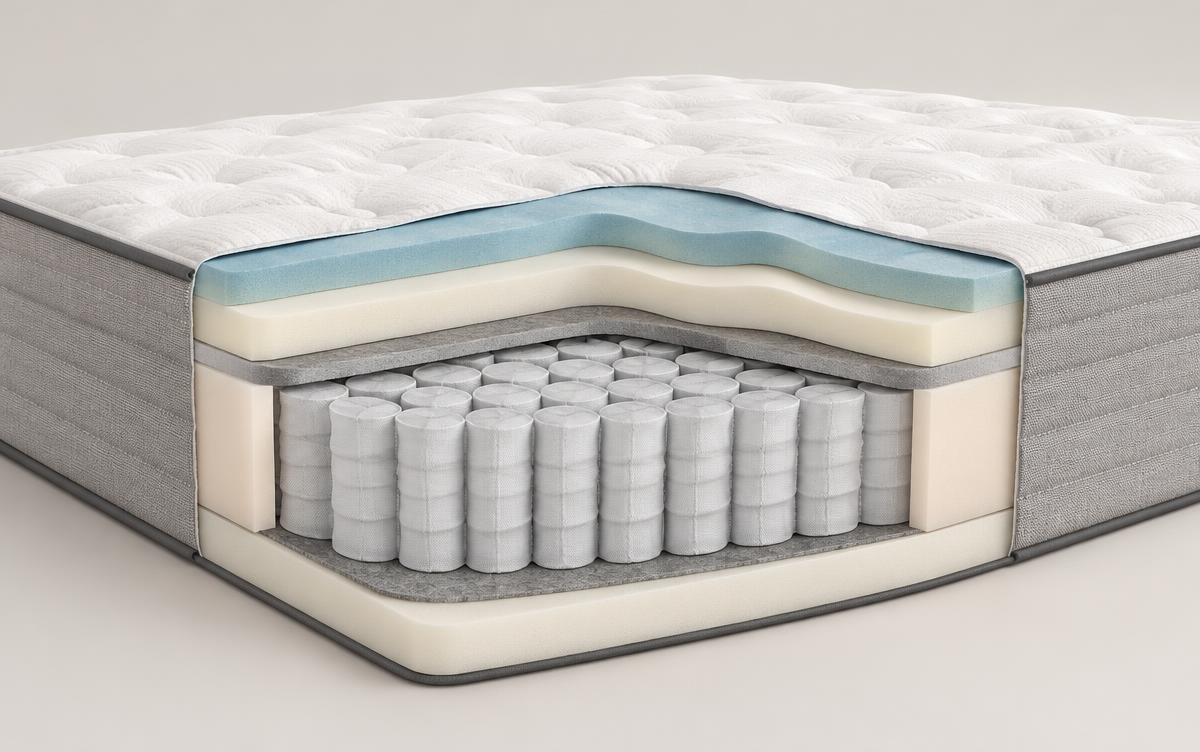
Compare like constructions whenever possible. An all-foam memory foam mattress and a latex hybrid differ in both comfort material and support core. If one feels springier, the coils may be part of the reason. Read the memory foam guide and latex guide for the material details, then request a complete layer list for the beds you are considering.
Memory foam vs latex mattress comparison
| Factor | Memory foam tendency | Latex tendency |
|---|---|---|
| Contour | Closer, slower-forming cradle | More buoyant, quicker recovery |
| Movement | Deep sink may resist turning | Often easier to reposition |
| Partner disturbance | Often strong motion absorption | Springiness may be noticeable |
| Warmth | Close contact may trap warmth | Less enveloping feel may help airflow |
| Handling | Weight varies by construction | All-latex beds can be very heavy |
| Composition | Polyurethane-based foam | Natural rubber, synthetic rubber, or blends |
Pressure relief and sleeping position
Side sleepers need room for the shoulder and hip to settle without leaving the waist unsupported. Memory foam can provide a gradual cradle, while softer latex can cushion with more pushback. Either can feel too hard if the upper layers barely compress, or too soft if the pelvis sinks disproportionately. Test for a relaxed shoulder and sustainable posture rather than assuming that deeper contouring always means better pressure relief.
Back sleepers often prefer moderate contouring around the lower back and pelvis. Stomach sleepers may need shallower cushioning to avoid excessive midsection sink. Combination sleepers should practice turning repeatedly: the difference between slow response and buoyant recovery may matter more than the firmness number. Use the firmness scale to narrow the initial range without treating it as a standardized measurement across brands.
Which is better for back pain?
Neither material can be named a universal winner. Back pain has many causes, and comfort depends on the balance of surface cushioning and deeper support. A soft latex bed can permit too much sink, while an overly firm memory foam bed can create pressure. A well-matched version of either may feel better than a worn or unsuitable mattress, but that is not evidence of a cure.
A frequently cited 2003 Lancet trial by Kovacs and colleagues found better outcomes with medium-firm than firm mattresses in people with chronic nonspecific low back pain. It did not establish that memory foam beats latex or that a particular retail firmness number treats every condition. See firm versus soft mattresses for back pain for the practical limits of that evidence.
Heat and motion: decide what bothers you most
People who dislike feeling enclosed may prefer latex, while very motion-sensitive couples may appreciate memory foam’s damping. Those preferences can conflict within a couple, so test both people turning and getting out of bed. The cover, support core, frame, and foundation influence what travels across the bed. A material comparison cannot predict the complete motion behavior of an untested mattress.
Latex often allows a less body-hugging surface, but it is not a cooling device. Memory foam with a breathable cover may work well for some warm sleepers, while thick bedding can make either material uncomfortable. Compare protectors and sheets as part of the sleep system. Cooling gel, perforations, or a cool-to-touch cover should be treated as design features rather than proof of sustained overnight cooling.
Durability, natural content, and sensitivities
Latex can be resilient, while memory foam quality varies substantially with formulation and construction. Neither has a guaranteed lifespan. Softness, repeated loading, moisture, support beneath the bed, and the quality of all the other layers matter. Density can help describe foam but is not a firmness score or a complete durability forecast. A long warranty also does not promise unchanged comfort for its entire term.
Memory foam is synthetic; latex can be natural, synthetic, or blended. Natural does not automatically mean safer for every sleeper or lower impact in every respect. Ask what certifications actually cover and avoid broad green claims without documentation. People with diagnosed latex allergy should consult their clinician before choosing latex. Initial odor and emissions testing are separate questions from natural content, and either deserves specific answers from the seller.
A practical side-by-side test
- Use your usual pillow and spend time in every position you regularly sleep in.
- Wait long enough for slow-response foam to settle rather than judging only the first touch.
- Roll over, sit at the edge, and get up to assess movement and perimeter stability.
- Compare trial rules, return costs, foundation requirements, and delivery arrangements before paying.
If you like a close hug and prioritize reduced partner disturbance, start with memory foam. If you prefer quicker movement and a more buoyant sensation, start with latex. If neither is quite right, compare a hybrid mattress with the preferred comfort material above coils. Your home trial should confirm the choice through consistent comfort, not pressure you to tolerate worsening symptoms.
Frequently asked questions
Is latex always firmer than memory foam?
No. Both materials come in multiple firmness levels. Compare complete mattresses and how deeply you engage their comfort and support layers.
Which material is better for heavier sleepers?
Either can work with appropriate support, durable layers, and a suitable load rating. A firm surface alone does not prove a construction will manage a heavier load well.
Can either mattress be organic?
Some latex and textile components can carry organic certifications. Memory foam itself is not organic latex. Verify the scope of any claim rather than assuming it covers the complete bed.
Should I choose based on lifespan alone?
No. A durable bed that does not fit your body is not good value. Balance comfort, construction transparency, practical handling, and a usable return policy.
Ready for the next step?
Explore the mattress buying guide