The Ultimate Guide to Mattresses for Back Pain Relief
A mattress for back pain should let you rest comfortably without excessive sinking or concentrated pressure. There is no universally best material or firmness, and a mattress cannot diagnose or cure the cause of pain. Start with your sleep position, the condition of your current bed, and a realistic home trial.
By the Sleep Comfort Insights editorial team at Essential Systems · Last reviewed
What a mattress can—and cannot—change
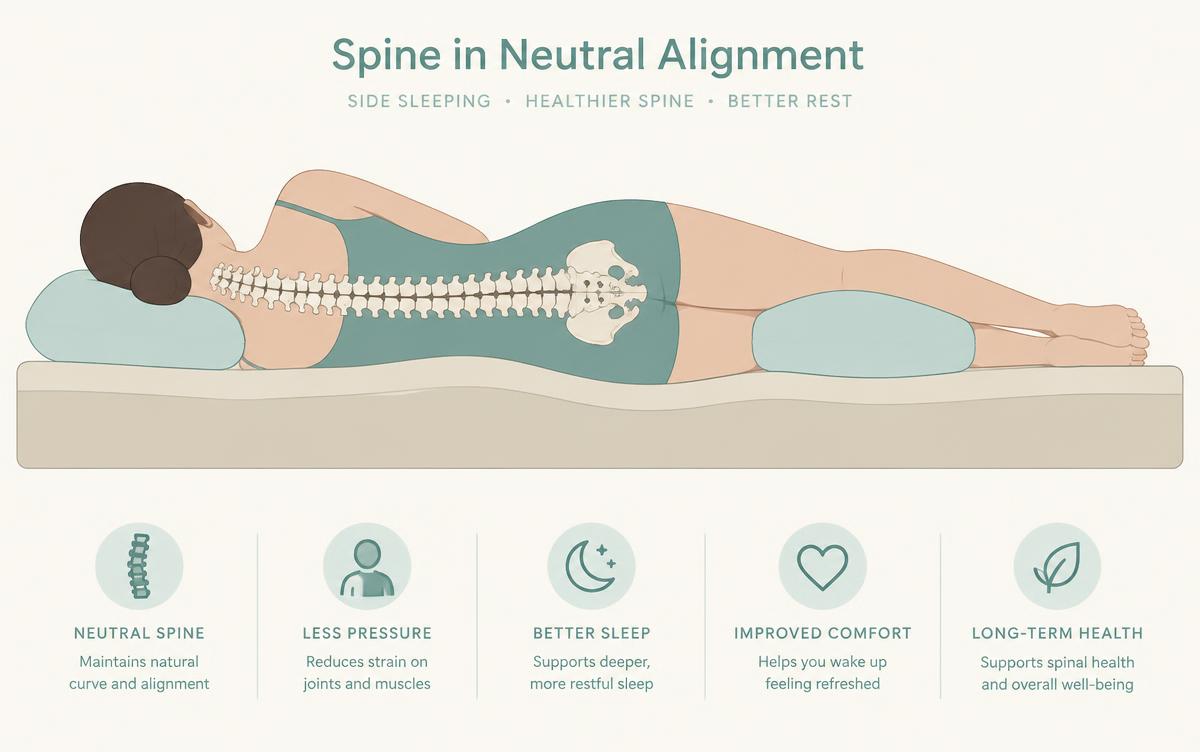
Your bed changes how your body is supported for several hours at a time. A surface that lets your pelvis sink much farther than your chest may feel tiring, while a very hard surface may press against your shoulders and hips. Either can make settling down difficult. Improving comfort may reduce sleep interruptions, but improvement does not establish that the mattress caused the underlying problem. Back pain also relates to activity, injury, stress, and medical conditions.
Think of the goal as comfortable, sustainable support rather than a perfectly straight spine. Normal spinal curves remain when you lie down. The science of sleep and spinal alignment explains why mattress diagrams cannot tell you whether your individual posture is healthy. If pain is getting worse, seek care rather than repeatedly buying firmer beds.
Separate firmness, support, and pressure relief
Firmness describes the surface sensation when you first lie down. Support describes how the whole mattress resists and distributes your weight. Pressure relief describes how the surface cushions prominent areas. A soft comfort layer can sit over a stable core; a hard-feeling mattress can still have a worn-out center. Compare the mattress firmness scale as a vocabulary tool, not a standardized medical prescription.
A frequently cited 2003 Lancet trial by Kovacs and colleagues found better outcomes with medium-firm rather than firm mattresses among adults with chronic nonspecific low back pain. That supports questioning the old advice that harder is always better. It does not prove every medium-firm mattress works, establish a best material, or apply automatically to every spinal condition.
Start with your usual sleeping position
| Position | Useful starting point | What to watch for |
|---|---|---|
| Side | Enough cushioning for shoulders and hips | Pressure, a hanging waist, or excessive pelvic sinking |
| Back | Even support with comfortable contouring | A deep pelvic dip or uncomfortable pressure under the back |
| Stomach | A surface that limits deep midsection sinking | An exaggerated lower-back arch or persistent neck discomfort |
| Combination | A balance of contouring and easy movement | Feeling trapped when turning or unsupported in one position |
Use our side sleeper guide and back sleeper guide to narrow the first beds you try. These are starting points, not rules. Body shape, weight distribution, mobility, and personal comfort can matter as much as position. Two people of the same weight may experience the same bed differently.
Choose materials for practical needs
Memory foam often provides a close contour and can reduce motion transfer, but some sleepers find it warm or slow to respond. Latex tends to feel more buoyant and easier to move across, although it can be heavy and may transmit more movement. Our memory foam versus latex comparison explores those differences without treating either material as a pain treatment.
Innerspring beds usually emphasize bounce, while hybrids add more substantial foam or latex comfort layers above coils. Coil count alone cannot predict support: wire design, comfort-layer thickness, base construction, and the interaction between layers all matter. A taller mattress is not automatically more supportive. Check the complete construction rather than relying on a category name.
Account for symptoms without self-prescribing
Persistent low back pain
If pain is recurrent or limits daily life, discuss it with a clinician. Ask about activity, rehabilitation, and sleep positioning rather than seeking a mattress prescription alone. A diagnosis may change which positions are comfortable, but a diagnostic label does not translate reliably into one firmness number.
Radiating pain, stiffness, and mobility limitations
Pain extending into a leg, tingling, or weakness deserves medical assessment. If getting out of bed is difficult, test edge stability and overall bed height as well as surface feel. An adjustable bed may make some positions more comfortable, but elevation is not a cure and requires a compatible mattress. Follow condition-specific advice from your treating professional.
Test a bed as a system
- Check that your foundation is sound and meets the mattress maker’s support requirements.
- Try your usual position with a pillow similar to the one you use at home.
- Turn over and get out of bed; comfort includes safe, manageable movement.
- If you share a bed, test together and compare edge compression and movement transfer.
- Read the trial terms before paying, including pickup, return fees, and any required break-in period.
During a home trial, record morning discomfort, nighttime awakenings, and ease of movement. Keep activity and bedding reasonably consistent so changes are easier to interpret. Look for a pattern over several nights rather than judging a single unusually good or bad morning. Do not endure escalating pain to satisfy a suggested adjustment period; contact the retailer and your clinician when appropriate.
Make a buying decision without cure claims
Before replacing the bed, inspect for sagging, broken supports, and unsuitable slat spacing. A topper may soften a sound but overly hard surface; it will not reliably repair a failed core. Our buying guide covers measurements, budgets, and return logistics. Compare mattress profiles in our back pain selection guide without assuming a product label establishes clinical benefit.
Frequently asked questions
Is the firmest mattress best for back pain?
No. Excessive firmness can create pressure and discomfort. Medium-firm is a reasonable starting point for many people, but a comfortable balance of cushioning and support matters more than the label.
Can a topper fix a sagging mattress?
Usually not. A topper follows the underlying surface and cannot restore a failed support core. Check the foundation and warranty before adding more material.
Should I replace my pillow too?
Check it rather than automatically replacing it. A different mattress changes how deeply your shoulders sink, so your old pillow may no longer hold your neck comfortably.
How long should I tolerate pain on a new bed?
There is no medically required break-in period. Mild unfamiliarity may settle, but persistent or worsening pain should prompt reassessment and medical advice, not forced endurance.
Ready for the next step?
Plan your mattress purchase