Best Mattresses Under $500: Budget Profiles and What to Expect
A mattress under $500 can be perfectly comfortable, but it usually involves trade-offs in thickness, durability or sizing. This guide explains which budget profiles tend to give the most for the money and how to avoid false economy.
By the Sleep Comfort Insights editorial team at Essential Systems · Last reviewed
What a $500 budget usually means
Prices vary by size, retailer and sales, so we do not quote prices for specific products. As a general rule, a budget at this level more often covers smaller sizes or simpler construction. A queen or king usually stretches the budget further than a twin or full. Check our mattress size guide before deciding.
Cheaper mattresses tend to use thinner or lower-density comfort layers, which can soften or develop impressions sooner. That does not make them poor choices, particularly for guest rooms, kids' rooms or short-term needs. It does mean reading the spec sheet and the warranty closely.
Budget profiles compared
| Profile | Suits | Pros | Cons |
|---|---|---|---|
| Medium-firm all-foam with a firm base | Back and side sleepers of average weight | Pressure relief, quiet, often compressed for shipping | Can sleep warm; may soften early |
| Simple innerspring with thin foam top | Guest rooms, stomach sleepers, hot sleepers | Breathable and bouncy | Weaker pressure relief, more motion transfer |
| Thin hybrid | Budget-conscious back sleepers | Supportive with some cushioning | Comfort layers are shallow |
| Firm foam or foam-over-coil for kids | Children and teens, short-term use | Low cost, firm support | Limited durability |
Profile details
Best value profile: medium-firm all-foam
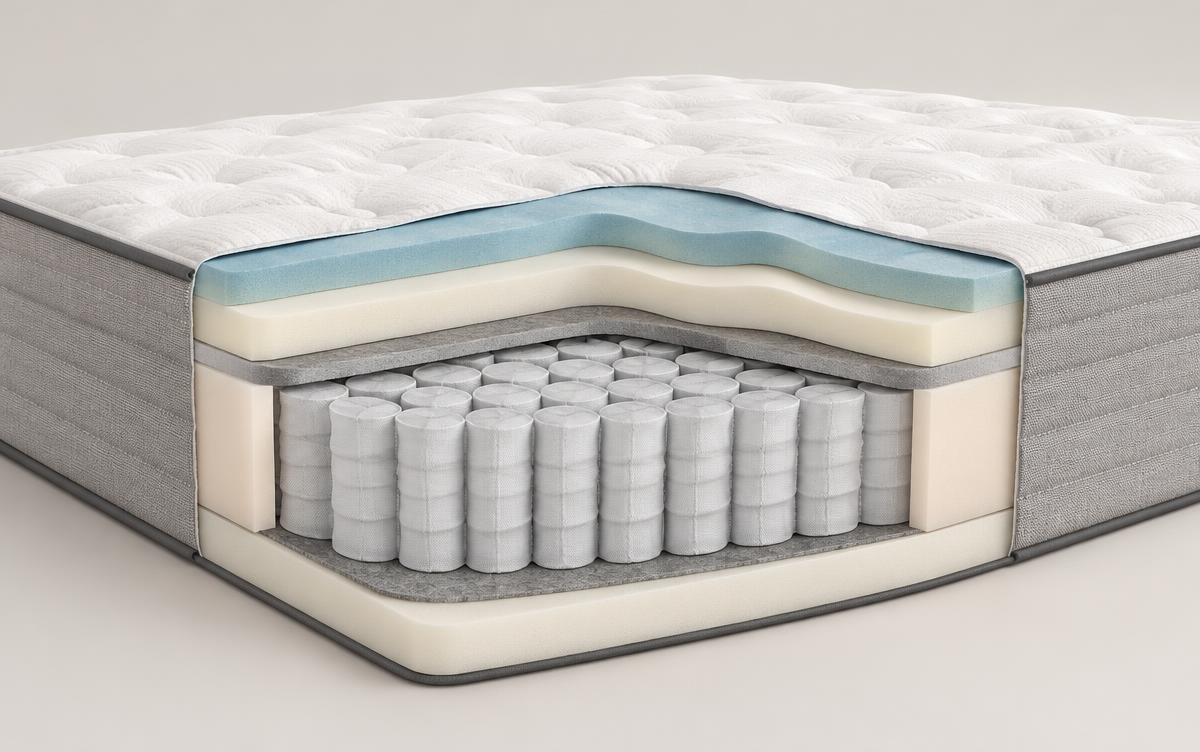
Dense polyfoam or memory foam over a firm base is the most common construction at this price. It suits many sleepers if the base foam is genuinely supportive. Learn more in our memory foam mattress guide.
- Who it suits: lighter to average-weight sleepers who want contouring.
- Cons: heavier people may find it sags sooner.
- Spec check: foam density, total thickness (at least around 8 to 10 inches is common), and certification for low emissions.
Best for breathability: simple innerspring
A basic innerspring has plenty of airflow and a lively feel. It is less ideal if you need pressure relief for shoulders or hips.
Best step-up: budget hybrid
A slim hybrid gives coils with a modest cushioning layer. It can be an attractive compromise if you find one with a sturdy coil core.
Where cheap mattresses cut corners
- Lower foam density, which affects how long the surface keeps its shape.
- Thinner comfort layers, meaning less pressure relief.
- Fewer or lighter-gauge coils and weaker edge support.
- Shorter or more conditional warranties; see warranties and return policies.
- Return fees or restocking charges that can erase the savings.
How to get the most from a small budget
- Prioritize support first, then cushioning, then extras like cooling covers.
- Look for a trial of at least 30 nights and learn what returns cost.
- Use a mattress protector to extend the life; see how to clean and maintain a mattress.
- Compare against the full buying guide so you do not skip key steps.
- If back pain is a factor, see the best mattress for back pain overview and consider whether a slightly higher budget is worthwhile.
Can I get a good mattress for back pain under $500?
Possibly, especially in smaller sizes. Look for a medium-firm feel and a supportive base, and use a trial period to test it.
Are mattresses in a box lower quality?
Not inherently. Compression packaging is a shipping method; quality depends on materials and construction.
Is it worth buying a mattress on sale?
Sales can help, but compare the same spec across retailers and check return terms before buying.
What is the most important spec at a low price?
The density and thickness of the support and comfort layers, plus the warranty terms.