Pillows for Back Pain: Finding the Right Support for Your Sleeping Position
The best pillows for back pain help you rest comfortably without forcing the head, trunk, or legs into awkward positions. Head-pillow height depends on your sleeping position and how far you sink into the mattress. Knee or body pillows may help comfort but cannot repair a sagging bed.
By the Sleep Comfort Insights editorial team at Essential Systems · Last reviewed
Understand what a pillow can change
A pillow can alter the position of your head, neck, shoulders, knees, or pelvis. That can make resting more comfortable, but it cannot identify the source of pain or guarantee relief. A head pillow that pushes the neck upward may be uncomfortable even on a supportive mattress. Conversely, repeatedly buying pillows may not help if the mattress has a deep depression that twists the torso. Evaluate the whole setup before treating an accessory as the missing cure.
Start with your usual sleep position and actual mattress, not a label such as orthopedic or therapeutic. Loft means pillow height, but the relevant height is what remains under your head after the fill compresses. A tall soft pillow may flatten more than a thin firm one. Shoulder width, head position, and mattress sink all influence the space to fill. Our back-pain guide explains how these parts interact.
Match head support to your sleeping position
For side sleeping, the pillow should fill the gap between the head and mattress after the shoulder settles. Aim for a relaxed neck without the head tilting strongly toward the bed or toward the ceiling. A deeper-contouring mattress may require less pillow loft than a firm surface. If you tuck an arm beneath the pillow every night, you may be compensating for inadequate height, although habit and comfort can also explain that behavior.
Back sleepers often need less height than side sleepers. The pillow should support the neck without pushing the chin toward the chest. Stomach sleepers may prefer very little loft or no head pillow if comfortable, because extra height can increase neck extension. These are starting points, not universal rules. Compare the side-sleeper setup and back-sleeper setup if you alternate positions or are unsure which posture drives your symptoms.
| Position | Useful starting point | Sign to adjust |
|---|---|---|
| Side | Enough loft to fill the shoulder-to-head gap | Head drops or tilts noticeably upward |
| Back | Moderate support under head and neck | Chin is pushed toward the chest |
| Stomach | Very low loft if any | Head feels lifted backward |
| Combination | Adjustable or flexible fill | Support suits one position but feels awkward in another |
Use knee and body pillows without overcorrecting
A pillow between the knees can reduce direct joint pressure and help keep the upper leg from rotating the pelvis forward during side sleeping. Supporting the lower legs as well may feel more balanced than a small thick wedge only at the knees. The goal is comfortable leg spacing, not pushing the top hip sharply upward. Start with a spare pillow and adjust thickness gradually. More bulk is not necessarily better support.
Back sleepers sometimes find a pillow under the knees reduces lower-back tension. A modest bend may be enough; a high stack can feel awkward or make it harder to move. A body pillow can provide something to hug and may keep the upper shoulder from falling forward. Do not use pillows to immobilize yourself or force a prescribed-looking pose. If an adjustment produces tingling, pressure, or pain, remove it and reassess rather than persisting.
Compare fills by feel and practical needs
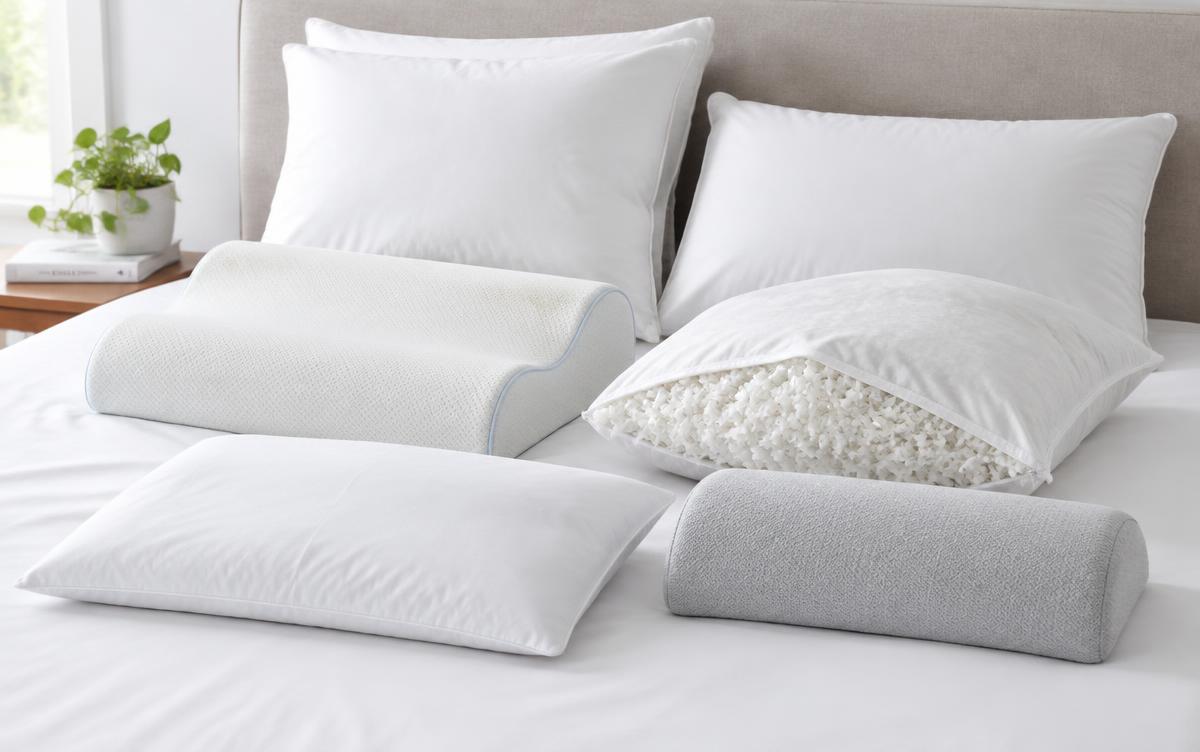
Memory foam can hold a shaped contour or conform gradually, but solid designs may feel warm or resist quick changes in position. Latex generally rebounds more quickly and may feel springier. Fiber fills can be easy to reshape but may compress or clump over time. Adjustable shredded fills allow loft changes, though their feel depends on the mixture and how evenly it distributes. None of these categories reliably predicts which pillow will be comfortable for an individual.
Consider washability, odor sensitivity, allergies, noise, and replacement covers along with support. Read the actual care instructions: a washable cover does not mean the entire pillow can be machine-washed. Claims about hypoallergenic materials do not guarantee freedom from allergy symptoms. If you have a known material allergy, check the full construction and ask your clinician about relevant exposure. Avoid interpreting a certification about emissions or materials as proof that a pillow treats pain.
Make a controlled adjustment at home
- Test the pillow on your regular mattress with your usual sleeping position, rather than judging only by squeezing it in a store.
- Start with a moderate loft and adjust one feature at a time so you can tell which change affects comfort.
- Allow the fill to settle under your head before checking whether your neck feels level and relaxed.
- Try turning and returning to your preferred position; a supportive pillow should not make normal movement cumbersome.
- Note morning comfort and awakenings, and review the return deadline before making prolonged experiments.
If your pillow allows fill removal, keep removed material clean and safely stored away from children and pets. Follow instructions for closing zippers and washing covers. With a shaped pillow, try the intended orientation before assuming either raised edge suits your neck. Do not place a rigid object under the neck to imitate a contour. A small, reversible comfort change is more useful than repeatedly increasing support because a product description promises stronger alignment.
Know when the mattress or medical assessment matters more
If your torso rolls into a depression or your pelvis sinks disproportionately, pillow height alone cannot restore a stable sleeping surface. Inspect the foundation and read when to replace your mattress. A pillow can complement a sound bed but cannot rebuild one. Similarly, neck or back symptoms that persist despite reasonable adjustments deserve assessment, especially if they spread into an arm or leg, disturb sleep repeatedly, or follow an injury.
Neck pillows and position supports are also not treatments for sleep apnea. Loud snoring, breathing pauses, or substantial daytime sleepiness should be discussed with a clinician. After surgery or with a diagnosed spinal condition, follow the positioning plan you have been given instead of substituting generic pillow advice. The stomach-sleeper guide discusses the limitations of low-loft adjustments when neck rotation remains the main source of strain.
Frequently asked questions
Is there one best pillow height for back pain?
No. The useful height depends on sleeping position, body proportions, mattress sink, and fill compression. Comfort under your head matters more than an unloaded measurement.
Should I put a pillow directly beneath my lower back?
A small support may feel comfortable for some people, but a bulky roll can force extension. It is not a universal recommendation or a fix for a sagging mattress.
How do I know when a pillow needs replacing?
Consider replacement when it no longer holds useful support, cannot be cleaned as directed, or has damaged materials. There is no single lifespan that fits all fills and usage patterns.
Can an expensive pillow guarantee pain relief?
No. Price, specialty shapes, and therapeutic language do not establish benefit for your condition. Fit, adjustable support, care needs, and workable return terms are more practical criteria.
Ready for the next step?
Explore the mattress buying guide